Home › Services › Landscape Retaining Walls
Landscape Retaining Walls in Newton, MA
Terracing, garden walls, and decorative walls that turn a sloped yard into something you actually use.
Call (617) 766-1539 for a free estimate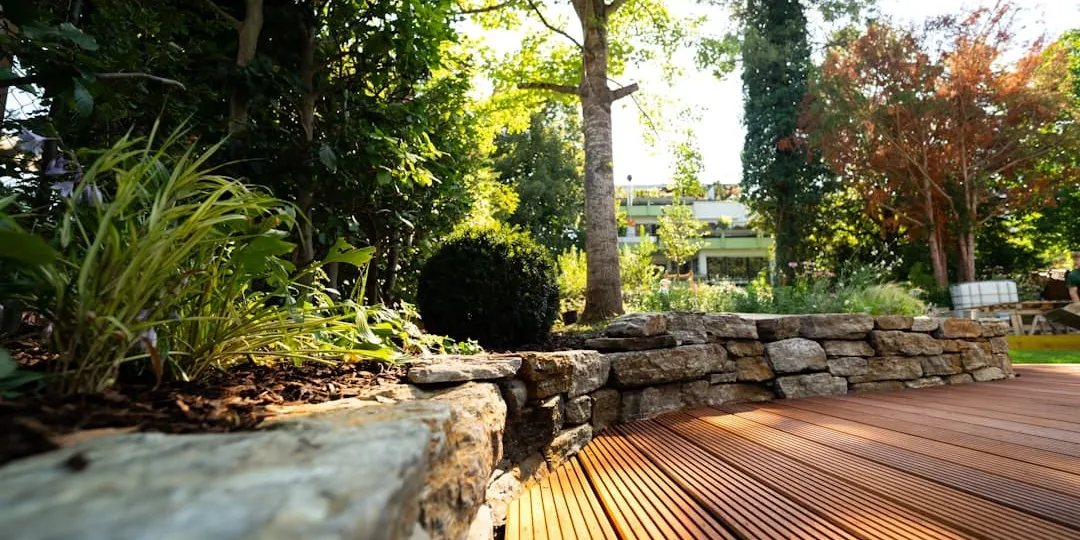
What this service covers
Landscape retaining walls are the smaller, design-focused end of the retaining wall world — walls that terrace a sloped yard, frame a garden, edge a patio, or create level space where there wasn't any. These walls are usually under 4 feet and often under 2, and the priority is aesthetics as much as function. We build landscape walls in segmental block, stone, timber, and poured concrete — the material depends on the look you want and the load the wall needs to carry. For Newton homeowners with sloped lots, landscape walls are the most cost-effective way to create usable outdoor space.
What Landscape Walls Do
The basic job is simple: a landscape wall holds back soil to create a level area where there was a slope. But that simple function unlocks a lot of possibilities. A terraced yard gives you flat planting beds on a hillside that was previously unusable. A low wall along a patio edge defines the space and creates a sitting surface. A garden wall frames a bed and keeps mulch from washing into the lawn during rain.
In Newton, where a lot of lots are sloped — especially in Newton Centre, Chestnut Hill, and the hillier neighborhoods near the Charles — landscape walls are how you turn a difficult yard into a usable one. We've built walls that created flat lawn areas on 15-degree slopes, that turned a washed-out garden bed into a stable terraced garden, and that edged patios so the outdoor space felt like a room rather than a corner of the yard.
These walls don't need to be structural in the engineering sense, but they do need to be built right. Even a 2-foot wall will lean and fail if the footing is inadequate or there's no drainage. We build landscape walls to the same standard as our structural walls — just smaller.
When You Need a Landscape Retaining Wall
Landscape walls are the smaller end of the retaining wall world, but they solve problems that bigger walls don't address. You might need a landscape wall if your yard has a slope that's too gentle for a structural wall but too steep to use comfortably, if you want to define a garden bed or patio edge, or if erosion is washing mulch and soil where you don't want it.
The most common reason homeowners call us for landscape walls is a sloped yard that's wasting space. If your backyard slopes enough that the lower section stays wet, the upper section is dry, and neither one is really usable, a low terrace wall fixes both problems — it creates a flat area and manages the water movement at the same time. This is especially common in Newton Centre, Chestnut Hill, and the neighborhoods near the Charles where lots are hilly.
Garden walls are the other common trigger. A low wall around a garden bed keeps mulch from washing into the lawn during rain, defines the planting area visually, and can even provide a sitting surface for weeding. A wall edging a patio or walkway serves the same purpose — it separates the spaces, holds back the ground behind, and makes the hardscape look intentional rather than ad hoc. Good garden wall construction is about more than just stacking stone — it requires the same attention to footing and drainage as a taller structural wall, just scaled down.
Sometimes the need is purely practical. If your driveway meets your lawn at a grade change, a low wall holds back the soil and prevents erosion. If your property line has a slope that's washing gravel onto the neighbor's side, a wall stops the movement. These are small projects — a day or two of work — but they solve a real problem and they look better than any alternative.
Materials for Landscape Walls
Segmental block is the most popular choice for landscape walls — affordable, available in a wide range of colors and textures, and easy to build with. For walls under 3 feet, block walls go up quickly and look clean. We can match block colors to your house or existing hardscape. Block is what we'd recommend for most landscape wall projects unless you have a specific aesthetic reason to choose something else.
Natural stone is the upgrade — fieldstone for a rustic look, or cut granite for something more formal. Stone landscape walls cost more but the payoff in appearance is significant, especially in Newton's older, stone-rich neighborhoods. A fieldstone garden wall looks like it was always there. Timber is the budget option — pressure-treated landscape timbers or railroad ties for a rustic, informal wall. Timber walls have the shortest lifespan in our climate (15-20 years) but they're the cheapest to install.
Poured concrete works for landscape walls too, especially when the wall is part of a larger hardscape project (a concrete patio with a seat wall, for instance). We can color and texture concrete to match any aesthetic.
Why Landscape Walls Fail
Landscape walls fail for the same reasons as their bigger structural cousins — poor footing, no drainage, and cheap materials. The difference is that landscape wall failures are slower and less dramatic, so homeowners tend to ignore them until the wall is visibly leaning or crumbling.
The most common failure is footing inadequacy. A 2-foot wall still needs a base — compacted gravel at minimum, and a proper footing if the wall is carrying any load. We see a lot of landscape walls in Newton that were installed directly on soil or on a thin layer of sand. Within a year or two, the base washes out or settles, and the wall starts tilting. It's the same failure mode as a structural wall, just slower because the forces are smaller.
Drainage matters even for low walls. A 2-foot fieldstone garden wall that's mortared will trap water behind it if there's no drainage path. The pressure builds until the mortar cracks and a section of the wall pushes out. Dry-laid walls don't have this problem — water drains through the gaps — but they need a compacted base or the stones shift and settle unevenly.
Timber walls have a specific failure mode: rot. Pressure-treated landscape timbers last 15 to 20 years in New England, and the failure is gradual — the wood softens at the ground line where moisture and oxygen meet, and the wall sags or collapses at that point. If your timber wall is more than 15 years old and showing signs of rot, replacement is the only option — you can't repair rot.
Repair vs. Replacement for Landscape Walls
Landscape walls are small enough that repair and replacement costs are closer together than they are for structural walls, which changes the decision math. A leaning 3-foot block wall might cost $500 to repair (re-level, add drainage) or $1,200 to replace entirely. At that ratio, replacement often makes more sense — you get a new wall with proper footing and drainage, and you're not paying to shore up a wall that may fail again.
For dry-laid stone landscape walls, repair is almost always the right call. Re-stacking shifted stones and rebuilding the base is a fraction of the replacement cost, and the wall goes back to its original condition. This is one of the advantages of dry-laid construction — repair is simple and inexpensive.
Mortared stone and brick landscape walls follow the same logic as their structural counterparts. If the mortar is cracking but the wall is otherwise sound, repointing the mortar joints and fixing the drainage is a cost-effective repair. If the wall has shifted significantly or the footing has failed, replacement is safer and often not much more expensive than a thorough repair.
Timber walls are the simplest decision: if the wood is rotting, replace. If it's just leaning because the footing settled, we can often straighten and re-stabilize without a full replacement. We'll tell you which one you're looking at when we assess the wall.
Terracing Sloped Yards
Terracing is the highest-impact landscape wall project. If your yard slopes enough that mowing is annoying or the lower section is unusable, a terrace wall (or two) can give you flat, usable space. The typical approach is to build one or more walls running across the slope, then backfill behind each wall to create a level area. The result is a series of flat zones — one for a patio, one for a lawn, one for a garden — instead of one continuous slope.
Drainage matters even for terrace walls. Each wall needs drainage stone and an outlet, or water builds up behind it and causes the same failure mode as a structural wall. We design terrace systems as a whole — the walls, the drainage, the grading — so the entire yard works together. A poorly designed terrace can actually make drainage worse, channeling water where you don't want it.
In Newton's hillier neighborhoods, terracing is often the difference between a yard you use and a yard you just look at. If you've been living with a slope, the transformation is worth it.
Cost and Timeline
Landscape walls are the most affordable retaining wall category. Segmental block walls under 3 feet typically run $20 to $35 per square foot, including footing and drainage. Stone landscape walls run $35 to $55 per square foot depending on stone type. Timber walls are $15 to $25 per square foot. Most residential landscape wall projects are completed in 1 to 3 days.
We give free on-site estimates for landscape wall projects. If you have a sloped yard or a garden that isn't working, call us — you might be surprised how much a simple wall can change the space.
Frequently Asked Questions
How much does a retaining wall cost in Newton, MA?
Most retaining walls in the Newton area run $20 to $60 per square foot depending on the material and wall height. Concrete and poured walls tend toward the higher end; landscape timber and segmental block walls are more budget-friendly. Every project is different — we give you a free, no-pressure quote so you know the exact number before any work starts.
Do I need a permit to build a retaining wall in Newton?
Newton requires a building permit for retaining walls over 4 feet tall (measured from the bottom of the footing). Walls under 4 feet usually don't need one, but it depends on site conditions and proximity to property lines. We handle the permit process for you — you don't have to deal with the town yourself.
How long does a retaining wall last?
A properly built retaining wall should last 50 years or more. The key word is "properly" — poor drainage, inadequate footing depth, and cheap materials cut that lifespan to 10-15 years. We build walls to handle New England freeze-thaw cycles, not just to look good on day one.
What's the best material for a retaining wall in Massachusetts?
It depends on what the wall needs to do. Concrete is the strongest and best for structural walls holding back significant earth. Natural stone looks the best and weathers beautifully. Segmental block (interlocking concrete blocks) is a great middle ground — durable, affordable, and available in textures that mimic stone. We'll recommend the right material for your specific situation, not whatever's most profitable for us.
Can you fix a leaning or cracked retaining wall?
Sometimes. If the wall is leaning less than 2 inches and the cracks are surface-level, repair is usually possible — we reinforce, re-drain, and stabilize. If it's leaning significantly or the footing has failed, replacement is safer and often cheaper than a repair that won't hold. We'll give you an honest assessment either way.